

the TikTok slideshow marketing experiment 👀
let’s get ish crackin. less ads, more content, tons of accounts.

the marketing experiment, part 1: how i'd get 5,000 visits without a single ad
gloves on. the value was never the app. the value is: can you actually market?
alright. gloves on. we're back in the marketing experiment — which is the whole point of the marketing department anyway. making marketing way less fucking hard.
here's the experiment: i'm turning off ads. completely. especially for my stealth app.
and to be clear — i could run ads. i have the money to. but that's exactly how you burn a pile of cash before you even know if people want the thing. i don't know yet if this app is something people truly want. and the oldest, most reliable way to find that out isn't a media budget. it's talking to your people.
quick reminder on the setup
i'm building an app that i'm not promoting with my personal brand. on purpose.
could i get my first 100 people to buy in just from my socials? easily. that alone probably gets it to a $1–2k/month app out the gate. but that's not the experiment. i want my personal brand disconnected from this — partly because it doesn't fit what i normally do (i build apps for businesses; this one's in the dating and relationship space, on the safety side), and partly because if my name is the reason it works, i've proven nothing.
honestly, this is probably an app i sell. if it's making $10k/month — $120k/year — multiply by 5 and someone might buy it for $500–600k. great outcome. runway for a lot of other things.
and yeah, i can already hear you: "if it did that well, you could've done this and this and this instead." i have tons of ideas. probably better ones. but that's not the point. the problem was never can i make money from an app. the problem is can i market it. so that's what we're testing. the app is just the vehicle.
case study #1: tiktok slideshows and the distribution machine
let's start where a lot of the smartest founders are already winning: tiktok slideshows and carousels.
go look at X right now. it's full of founders sharing their journeys and — most usefully — their actual marketing techniques. pat walls (starter story) blew up partly because he listened to what people wanted: how did they growth-hack this to $100k a month? and it almost always comes down to the same three levers — ads, content, and distribution.
alex hormozi built a huge piece of his machine on distribution alone. take one video, clip it up, put it everywhere — youtube, instagram, tiktok. not just his own pages. other pages too.
now apply that to an app.
the 10-account machine
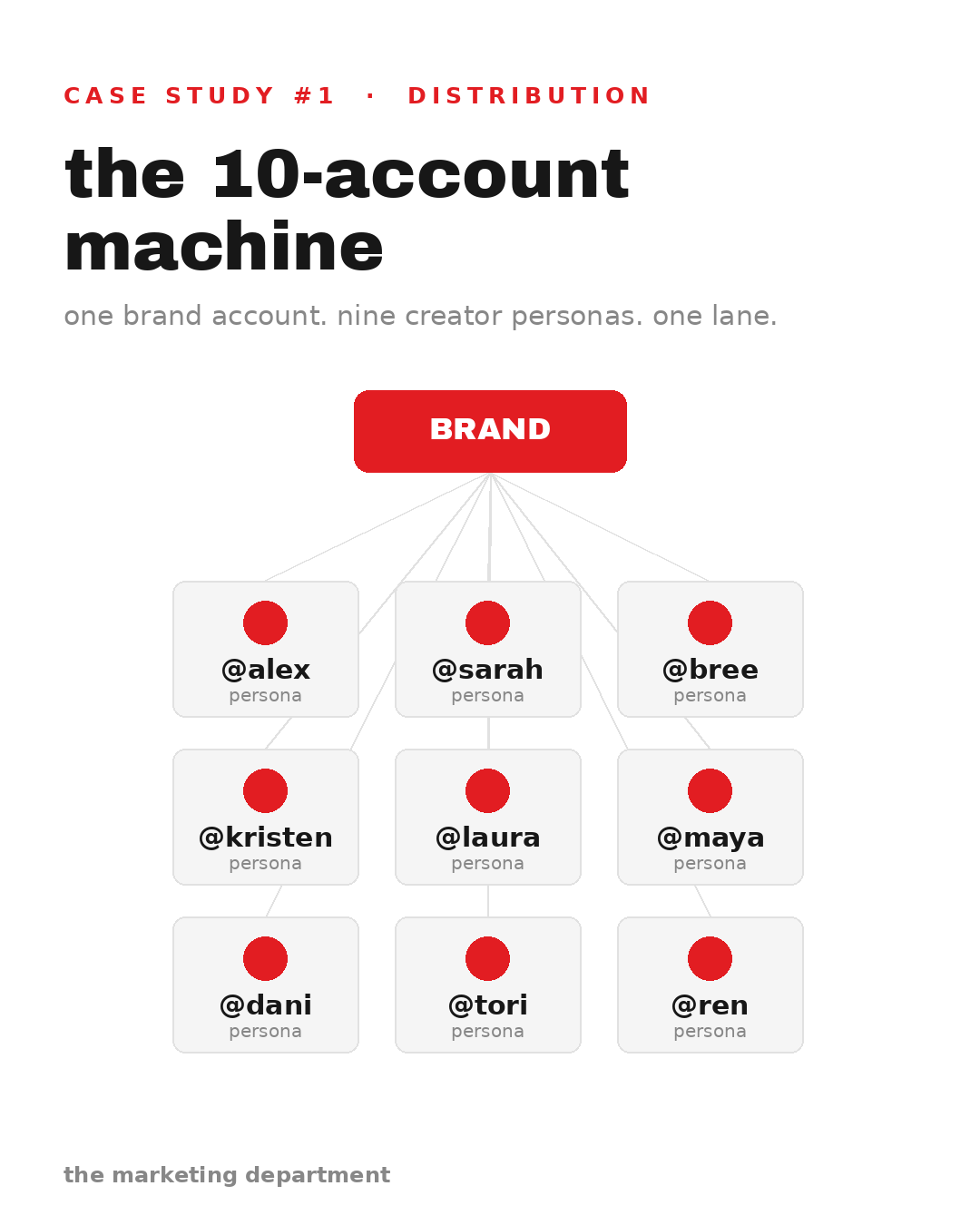
imagine one app running 10 tiktok pages and 10 instagram pages. twenty accounts. one app.
one brand account per platform. the rest are "creator" personas — each one a person obsessed with the same single lane. there's alex. there's sarah. there's bree. there's kristen. there's laura. different faces, same universe.
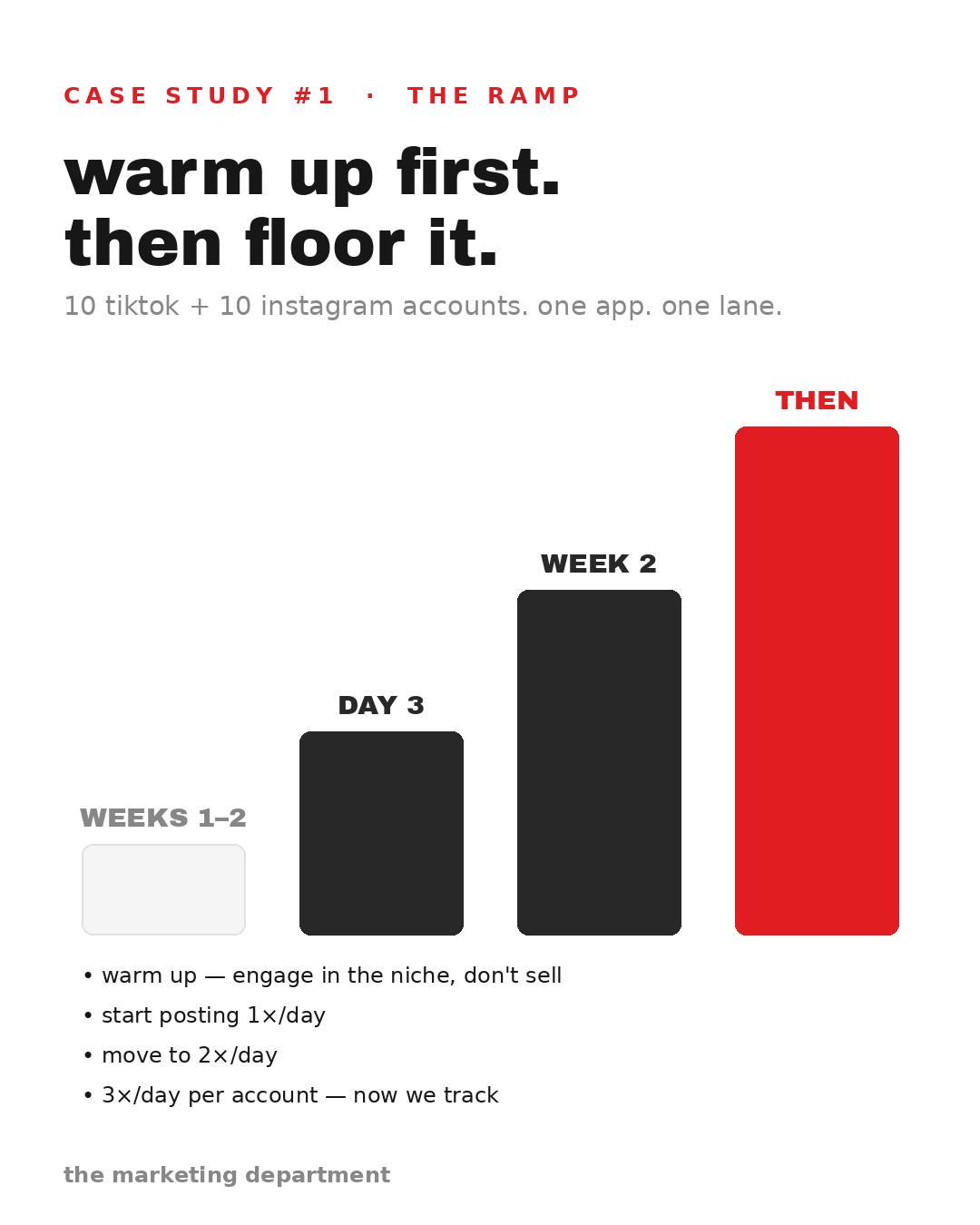
but you don't just flip all 20 on and start blasting. you warm them up first, or you get throttled.
the ramp:
first 2 weeks — warm up. don't sell anything. just engage with content already living in your app's niche. act like a real user of that world.
day 3 — start posting 1x/day per account while you keep engaging.
week 2 — move to 2x/day.
then it's on. 3x/day per account, and now we track.
10 tiktoks + 10 instagrams all posting 3x/day in one lane? that's serious motion.
the math (low end on purpose)
even if the whole thing only pulls 500,000 views/month — and keep in mind i've had a single account hit 75k views in a month without even strategizing — that's already enough to learn what content works and what doesn't.
and this is the funnel that actually matters:
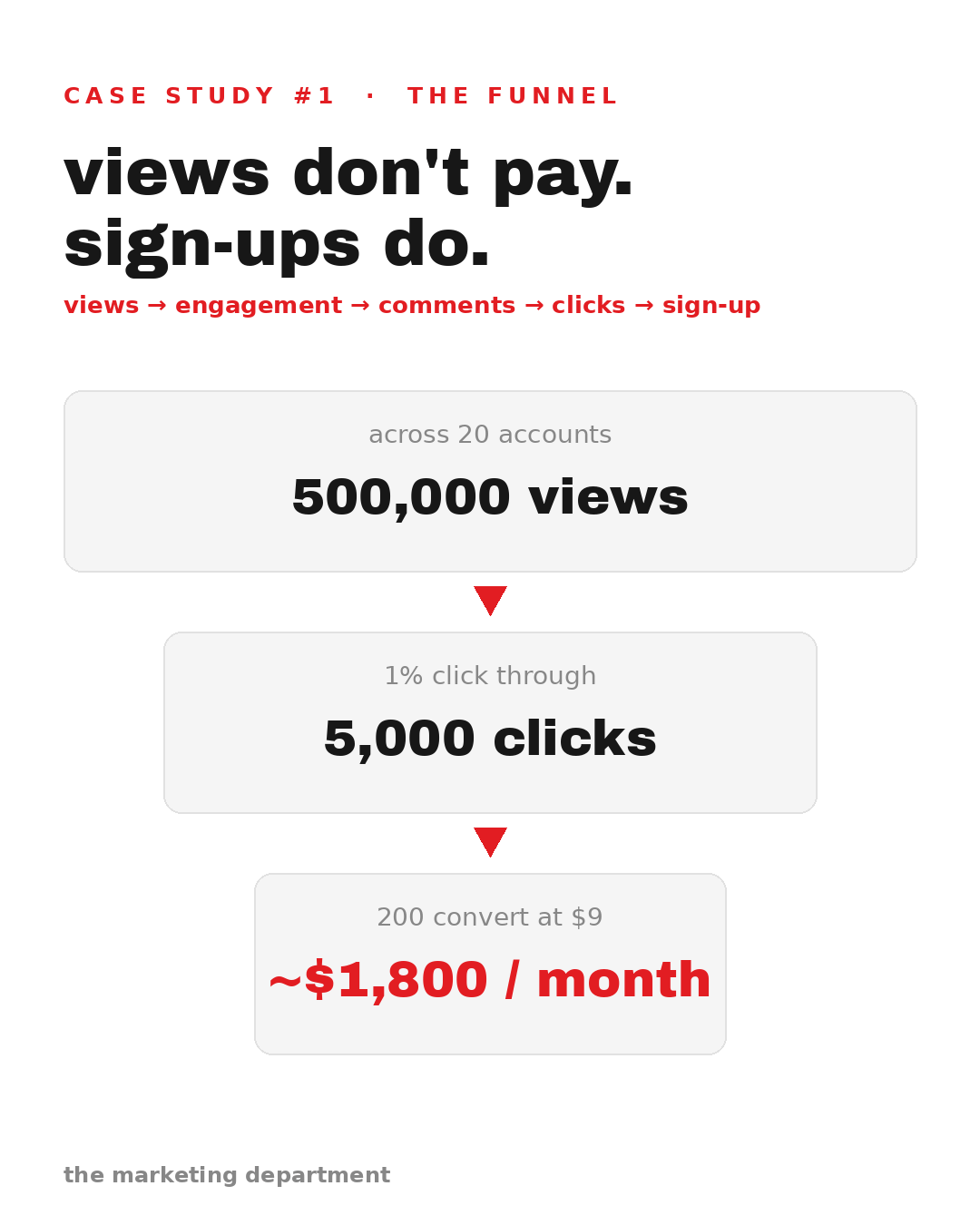
views → engagement → comments → clicks → sign-up = $$$
run the low-end numbers:
500,000 views across the accounts
→ 5,000 clicks to the site
→ 200 sign-ups
at $9, that's ~$1,800 in month one. from zero ad spend. remember — this is a web app with no free tier. every dollar in is from a paying user. i'm not spending money storing anything for people who aren't paying. that's the discipline i took from jem social: only spend money on an app that's already making you money.
why month one is never wasted (the part people miss)
here's the thing about a subscription model that ads-brained people forget.
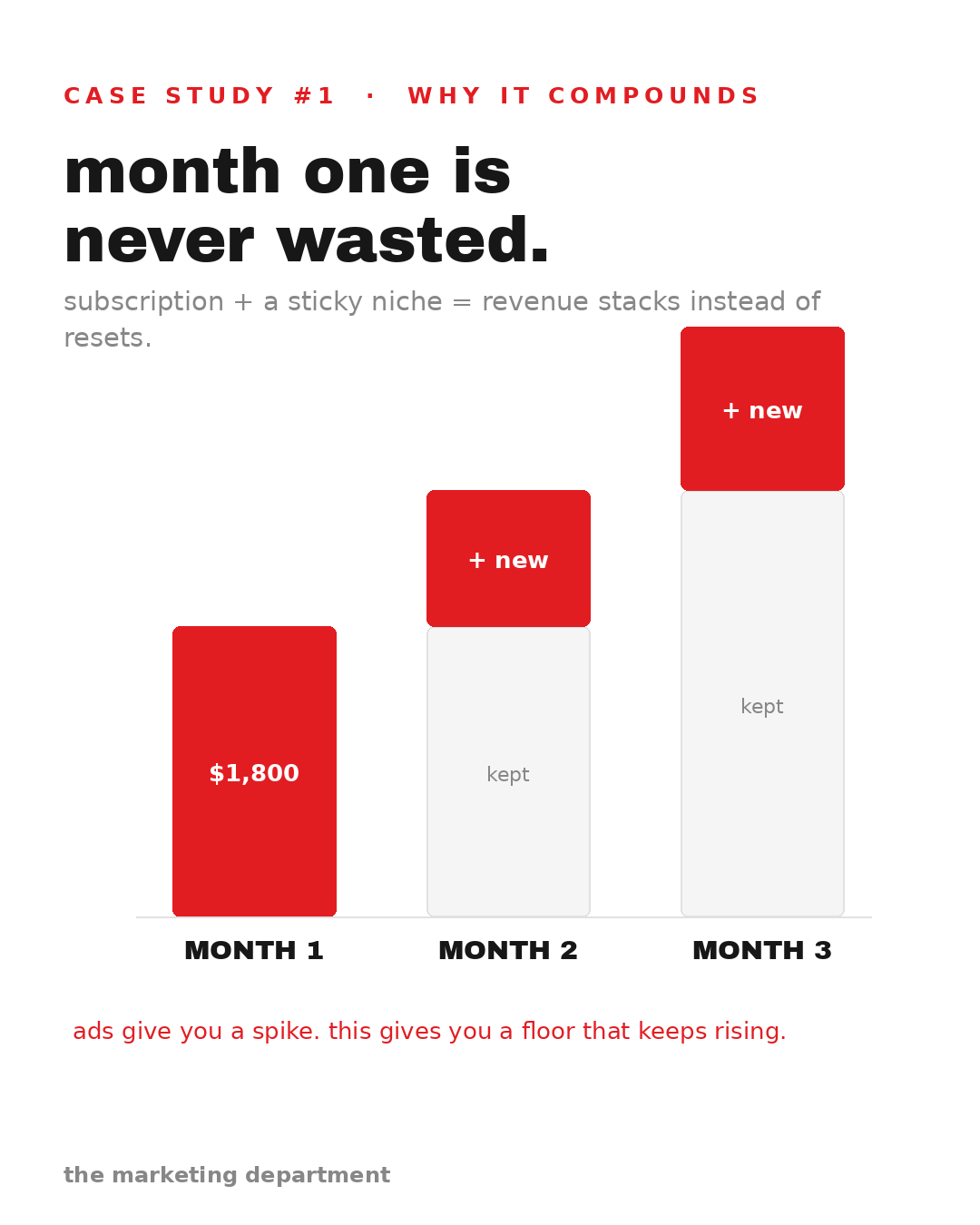
month one: 5,000 visits, $1,800. cool.
month two: say i hit the same numbers, maybe 20% better. but i'm building in a niche where people keep the tool — safety, "safer than sorry" — so i retain most of month one's users. which means month two's new revenue stacks on top of month one's, not instead of it.
directionally, none of the marketing work from month one was wasted. it compounds. that's the whole magic of a subscription plus a sticky niche. ads give you a spike. this gives you a floor that keeps rising.
then you reinvest
once it's moving, you scale the only thing that matters: the content engine. warm up more tiktok accounts. more instagram accounts. more shots on goal in the same lane.
"but what does the engine cost?"
this is the best part. you've got options:
run it with friends. pay a couple buddies a few hundred a month — it's under an hour a day to knock out reels.
fastlane — distribute short-form using templates or ugc videos on the platform.
jem social — work with real, small human creators to promote your product.
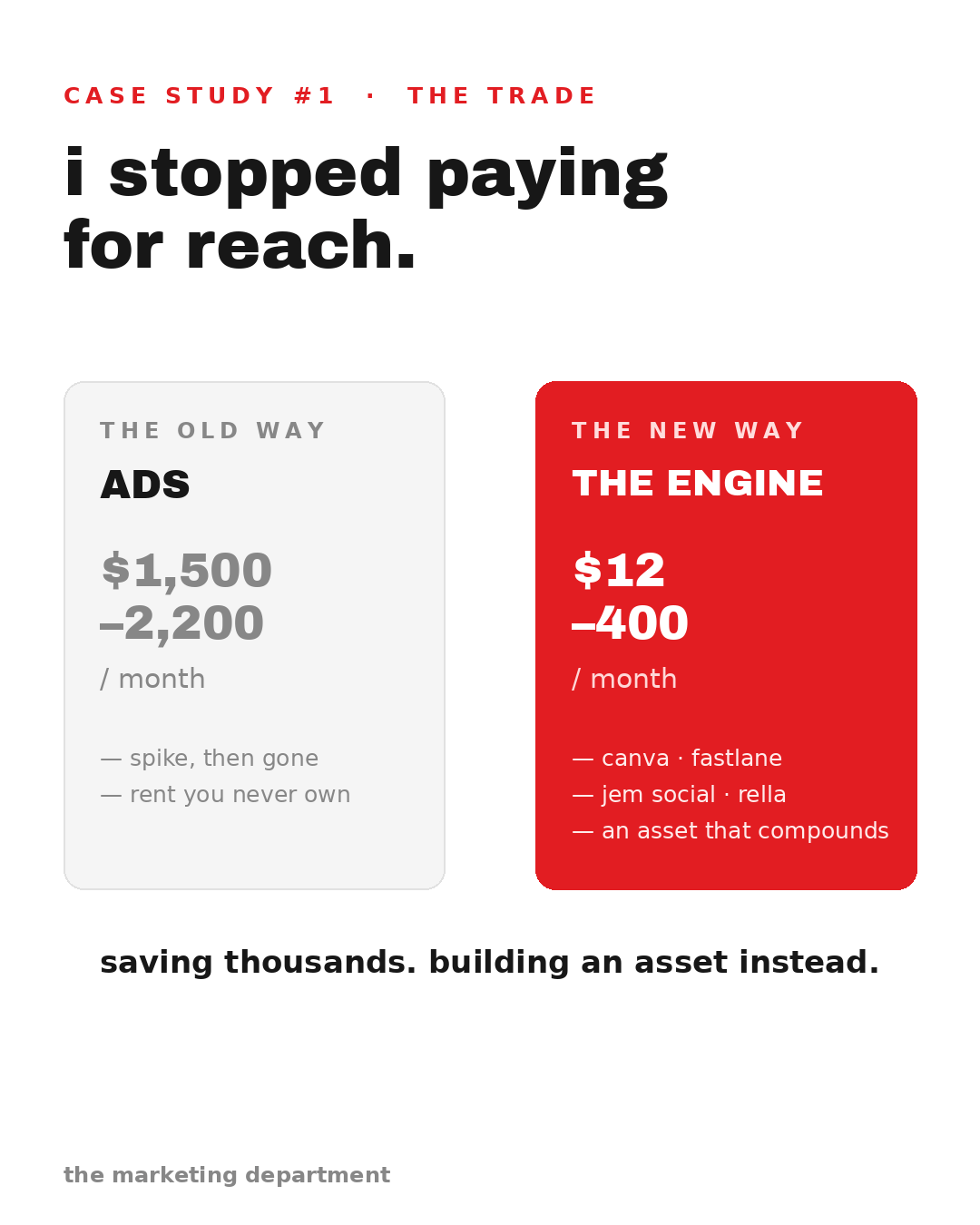
canva (the cheapest) — make the videos and tiktok slideshows yourself and schedule them out with rella.
all in, this engine runs anywhere from $12 to $400/month depending on the route.
now compare that to what i was doing: $1,500–2,200/month on ads. i'm saving thousands. yes, the warm-up takes time. yes, there may be a dip before it climbs. but as a model for growing my stealth app? it's beautiful.
and once i crack all the codes here, i rinse and repeat the playbook on the next app. because i'm building three more, i shit you not — and if this works, it's about to go apeshit.
to be continued. i'll update you as findings come in — and the second i hit a breakout lesson, you'll hear it here first..
cheers — to getting seen.