

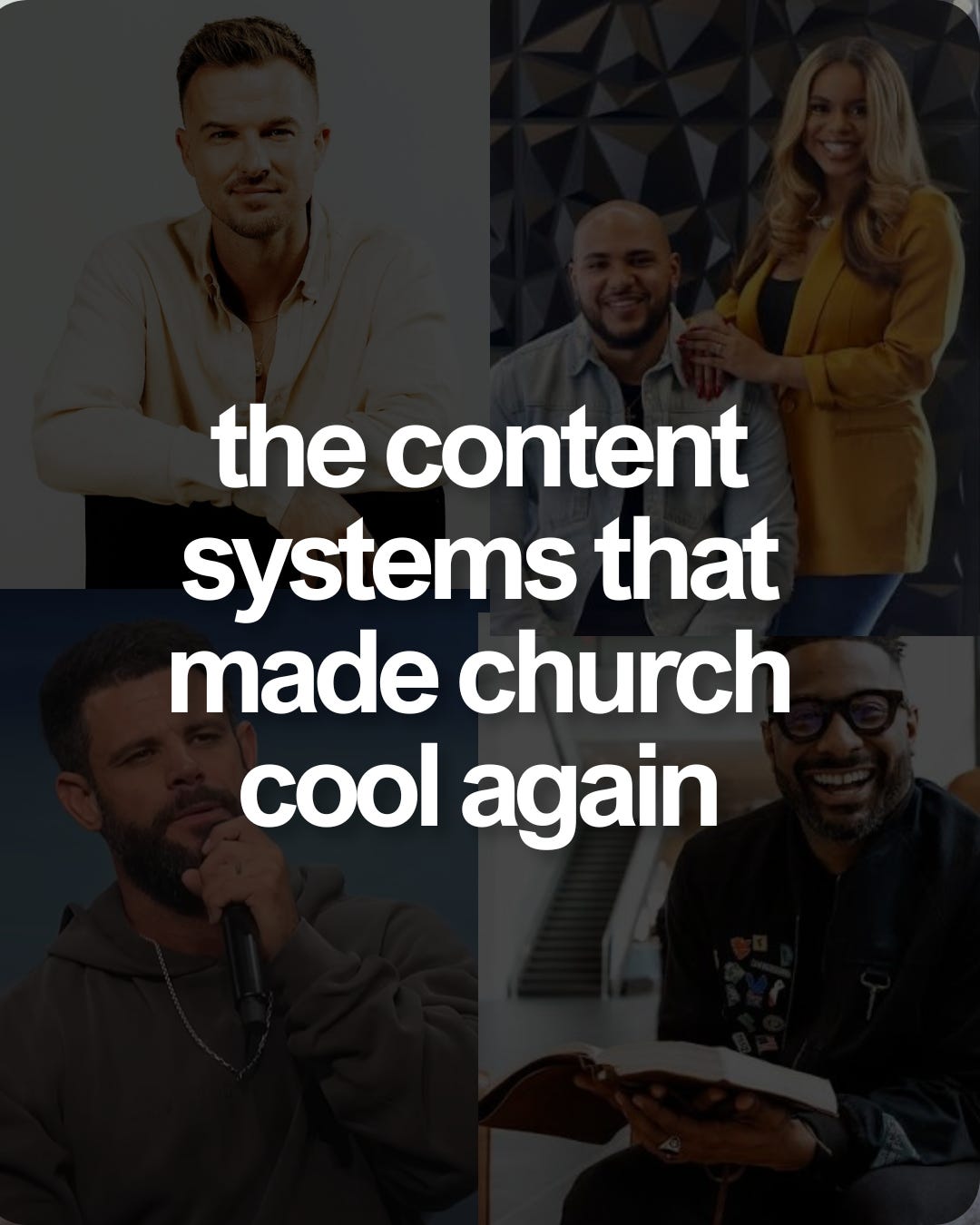
the content systems that made church cool again.
between the hooks, the message, the content, even i started going to church again...here's why.

let me say something that will offend the wrong people and unlock something for the right ones.
they made church cool again.
think about it. brunch is cool. drinking is cool. fashion is cool. conferences are cool. these pastors and their teams took the most unmarketable product on earth — building a personal relationship with God — and made it culturally relevant, aspirational, and something people actively want to be part of.
but here’s the part i want to focus on today. they didn’t do it through location. they didn’t do it through billboards. they didn’t do it through the same church-planting playbook everyone else was running for the last 50 years.
they did it through content systems.
that’s the whole game. and if you strip out the theology and look at what these four specific churches — vous, blueprint, garden, and elevation — are actually doing operationally, you’re looking at four of the most sophisticated content distribution machines in america. period.
these aren’t local churches anymore. they’re global brands. and the way they became global brands is the exact playbook your business should be running whether you’re building a saas, an app, a physical product, a service, or a movement.
let me break it down.
the framework — what a content system actually is
before we get into the four audits, let me define what i mean by “content system,” because most founders throw the word “content” around like it means one thing.
it doesn’t. a real content system has five parts:
1. a positioning. what specific lane are you owning that nobody else can own the same way.
2. a production engine. how you consistently produce content across multiple formats without burning out.
3. a distribution stack. the platforms, channels, and cadences where the content actually lives.
4. an owned ecosystem. the assets you own outright — email lists, communities, courses, books, podcasts, apps — that don’t depend on any single platform.
5. a conversion path. how someone goes from “i saw a clip” to “i’m all-in on what you’re building.”
every single one of the four churches i’m about to audit has all five parts locked in. that’s why they built global reach on local budgets. and it’s what most founders are still doing wrong.
let’s get into the audits.
audit 1 — vous church (miami)

pastor: rich wilkerson jr. and dawnchere wilkerson
location: miami
founded: 2015 (out of a wednesday-night youth service called the rendezvous)
notable moment: officiated kim kardashian and kanye west’s wedding in 2014
vous is a case study in celebrity-adjacent, aspirational lifestyle christianity. that’s their lane. and they own it because nobody else can plausibly claim it — you can’t fake being kanye’s pastor.
their content system leans hard on cinematic, high-production sunday services that look and feel like a music festival. the branding is minimalist, aspirational, monochrome. their instagram (285K followers on the church account, over 1.3 million combined between rich and dawnchere) feels less like a church account and more like a lifestyle brand. and that was intentional from day one.
what they did right:
they used every platform as a top-of-funnel tool. rich did a full reality tv show on oxygen (rich in faith), and while it only lasted one season, it exposed vous to millions of people who would never have walked into a church. he later said explicitly that these unconventional platforms are “tools” to reach people the church avoids.
their positioning invites the wrong people (by traditional standards). justin bieber. the kardashians. selena gomez. and instead of hiding that, they leaned in. their whole content strategy is “everyone is welcome here, especially the people other churches would judge.”
they built an owned ecosystem early. the annual vous conference is basically a music festival + christian gathering. it’s a distribution and community-building event they own outright. tickets sell out. the content from it becomes a full year of clips.
what your business should steal from vous:
cultural relevance is a positioning strategy, not a personality trait. you can decide to be the culturally relevant option in your category. jem social does this in creator marketing — we intentionally position ourselves as the platform culture-forward brands come to when they don’t want the “old marketing agency” energy. you should be doing the same in your category.
audience alignment beats mass appeal. vous didn’t try to be everyone’s church. they picked a specific aesthetic and vibe, and they went hard. the people who resonate, resonate deeply. the people who don’t, don’t matter. that’s the whole strategy.
audit 2 — blueprint church (houston)

pastors: matthew and falyn davis
location: houston, tx (now at bayou city event center after outgrowing their first location in one year)
founded: january 28, 2024
motto: “belong. become. build.” — they call new visitors “cousin” (”welcome home, cousin”)
blueprint is a completely different content play than vous. and that’s the point. they’re not trying to be vous.
blueprint owns “welcome home. the church for the next generation, no matter your past.” matthew and falyn davis are both houston natives, married in 2021, first-time parents to their daughter zoey. their whole positioning is family, home, belonging. the tagline “welcome home cousin” is not an accident — it turns first-time visitors into family members from the moment they walk through the door. that’s a positioning move most churches would never think of.
what they did right:
they scaled through cultural resonance, not just theology. blueprint’s tiktok has 326,900 likes and 14,600 followers, which is huge for a church that’s less than two years old. matthew’s personal instagram sits at 14K. and the reason is because their content doesn’t feel like a church posting sermons. it feels like a young houston couple building a movement they want you to be part of. that vibe converts. especially in a city like houston where cultural belonging matters as much as theology.
they grew so fast they had to move locations within their first year. blueprint launched january 2024 at 9371 richmond avenue. by january 2025 — one year later — they had outgrown it and moved to bayou city event center. that kind of growth in a saturated houston church market doesn’t happen by accident. it happens because their content system is doing serious work at the top of the funnel.
they run three sunday services (9:00, 10:30, 12:45) — which for a church less than 24 months old is an incredible signal. it means demand is exceeding supply. it means their content is bringing more people than any single service can hold. every founder should be jealous of that math.
what your business should steal from blueprint:
positioning language does invisible work. “belong. become. build.” is a three-word product roadmap. “welcome home cousin” is a customer experience strategy. those aren’t marketing taglines — those are the actual promise the church makes and delivers on. what’s the three-word promise your business makes? if you can’t say it, that’s your homework.
speed to scale is a content signal. blueprint outgrew their first venue in twelve months. if your business is not seeing that kind of demand pressure, the answer usually isn’t “we need a better product.” it’s “our content isn’t doing enough work at the top of the funnel.” blueprint is proof that when the content is right, growth outpaces infrastructure.
audit 3 — garden church (houston)

pastor: dr. manny arango and tia arango
location: houston (waltrip high school every sunday, no permanent building yet) — will be streaming soon.
founded: february 1, 2026
manny’s background: former teaching pastor at social dallas under robert and taylor madu, doctorate in new testament studies from northern seminary
garden is the newest of the four but it’s already a content masterclass. and it’s the one that converted me, so i’ll break this one down with the most receipts.
garden owns “phd-level biblical literacy for people who feel dumb about the bible.” that’s the lane. tbh, that would be me. i grew up catholic, went to catholic school and university and still… did not understand the bible. why? i didn’t care enough.
manny is a scripture scholar who can teach without being condescending. it’s authority + accessibility, which is the same combo that separates every category-defining creator from the rest of the pack.
what they did right:
manny built the audience for six years before he built the church. arma courses — his separate online biblical literacy platform — has been running since 2020 and grew to thousands of monthly subscribers. his personal instagram is at 109K, threads at 17.4K, plus a youtube channel (mannyarangotv) and a podcast (the bible department). by the time garden opened its doors in february 2026, manny wasn’t launching a new church. he was giving his existing audience a physical home.
the book preceded the church. crushing chaos: calm your storms. order your life. find your peace. was released by waterbrook on may 6, 2025 — nine months before garden church even existed. that book is a distribution and credibility asset that keeps working while he’s asleep.
they built an owned ecosystem that doesn’t depend on the church. arma courses, the book, the podcast, the speaking, the sermons at other churches — every one of these is a content asset that generates revenue and reach outside of the sunday service. garden church didn’t have to be financially self-sustaining from day one because manny’s content ecosystem was already funding the mission.
what your business should steal from garden:
build the audience before you build the business. if you’re planning to launch something in six months, twelve months, two years — start producing content today on the topic your business will serve. every day you spend building an audience before launch is a day your launch will land with the wind at your back instead of into a headwind.
build multiple assets that all reinforce the same positioning. manny’s book, courses, podcast, sermons, and instagram all say the same thing in different formats. that repetition is what makes people trust him. one channel, one format, one voice is fragile. five channels, five formats, one voice is undeniable.
audit 4 — elevation church (charlotte)
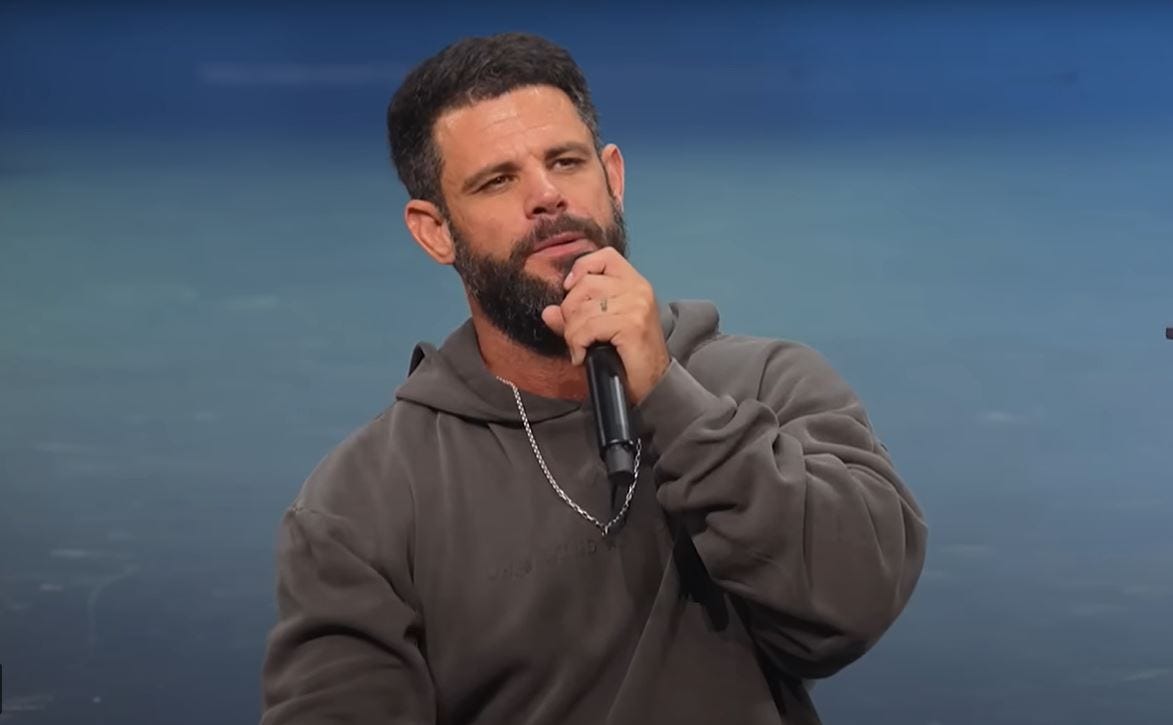
pastor: steven furtick
location: charlotte, nc + global via streaming
founded: 2006 in a movie theater
scale: $108 million in revenue in 2023. 93 million sermon streams that year. elevation worship music: 2.14 billion streams across youtube and spotify. in-person attendance up 21% year-over-year to 17,091 weekly.
elevation is the operational king. and if you’re a founder who cares about systems — this is the case study you cannot skip.
elevation runs their content operation like a real company. according to their own published organizational faq, they have a fully staffed communications department with a social director, individual social managers per brand channel (@stevenfurtick, @elevationchurch, @elevationworship, @elevationyth, @elevationoutreach), dedicated creatives per channel who handle video, motion graphics, and design, project managers for timeline and organization, and a lead designer who approves all execution.
that is not a church social media team. that is a fortune 500 content org.
what they did right:
they built a whole second brand around the music. elevation worship isn’t a sub-brand of the church — it’s a category-defining christian music label. “the blessing.” “graves into gardens.” “jireh.” these songs are streamed by people who have never attended elevation church and never will. the music is the top of the funnel that feeds everything else.
they matched sophisticated content to sophisticated ops. the reason they hit 93 million sermon streams is because they have a team of people whose entire job is making sure every sermon becomes 47 clips across every platform. they know the difference between a shorts clip, a reel, a tiktok, a full-length youtube video, a podcast episode, and an ig carousel. they treat each format as a distinct discipline.
they made pastor steven himself into a media property. he’s a grammy-winning songwriter, a new york times bestselling author (crash the chatterbox, greater, sun stand still, do the new you), a podcast presence, and a full personal brand separate from the church. that’s on purpose. it distributes their reach across more surface area than any one entity could occupy.
what your business should steal from elevation:
treat every piece of content as a raw asset that becomes many finished assets. one sermon becomes a shorts clip, a reel, a tiktok, a full youtube video, a podcast episode, an ig carousel, a newsletter section, a book chapter, a course module. most founders publish once and move on. elevation publishes once and multiplies infinitely.
staff for content the way you staff for engineering. elevation has more content operators than most tech startups have engineers. that’s the actual sign of whether you take distribution seriously — not what you say, but what you fund. if you’re not hiring for content roles, you’re not serious about growth.
the personal case study — how garden’s content converted me
let me put a face on this because i’m not just writing about strangers. one of these systems worked on me. well technically two because i started at blueprint church but, ended up making the garden my home and the receipts are worth walking through.

i am a 30 year old black neurodivergent queer woman. i live in houston. i grew up with a complicated relationship to the church and had spent most of my adult life at arm’s length from any kind of organized religion. i wasn’t looking to go to church. i was fine with praying to God and calling it a day.
deep down i knew that wasn’t…enough. i was lost.
then manny arango’s content started showing up in my feed.
what caught me was not what you’d expect. it wasn’t a hot take. it wasn’t a viral clip. it wasn’t a controversial sermon. what caught me was that this man knew what he was talking about and could teach it in language i could actually understand.
authority + accessibility. the same combo you see in every creator who builds a category-defining audience.
so i watched his short form clips on instagram. and i watched. and one sunday in may, i walked myself to house of blues (before they moved to waltrip high school) alone. nobody dragged me. nobody invited me. the content just did the work. this was the week before i decided to go into entrepreneurship full time and move to thailand.
here’s what happened next, in order:
may 2026 — started attending. showed up alone.
june 2026 — became consistent in prayer for the first time in years. started understanding the bible more. no external accountability required.
july 2026 — started inviting friends to church instead of brunch. (this alone should tell you how well the marketing worked. brunch culture is the culture in houston on a sunday. and i was picking church over it.) i started reading manny’s book. started tithing (which i never really did)
august 2026 — signed up to serve. started doing shadow work. started re-examining my faith with an open heart for the first time in a long time.
four months. content-only funnel. no ads. no hard sell. no invitation. just consistently good content across multiple platforms that spoke to a specific person the marketing was designed for.
that’s what works. and it’s what almost nobody in the founder world is doing at that level.
what your business should steal from all four playbooks
let me pull it all the way back so you walk away with something actionable this week.
your content is your marketing. not “part of it.” not “one channel.” it tells the story. all four churches are proof. their sermons are their marketing. their book is their marketing. their podcast is their marketing. the sunday service is the delivery of the promise the content already made.
build multi-format, multi-platform, single-positioning. every asset says the same thing in a different way. that’s the flywheel. one message, ten formats, five platforms, running continuously.
build the audience before you build the business. manny built for six years before garden opened. elevation built for 20 years and hit $108 million in revenue. audience-first businesses compound. product-first businesses beg.
pick a positioning nobody else can plausibly own. vous owns celebrity aspirational. blueprint feels like you’re seeing your cousin. garden owns phd accessibility. elevation owns operational scale. each one is defensible because it’s tied to something specific and hard to replicate. what’s yours?
staff your content operation like you mean it. if elevation has a full content org and you have “we’ll post when we can,” you know why you’re losing the distribution fight. hire for it. build for it. treat it as the engine of your business — because it is.
let people convert on their own timeline. it still took time. i probably saw their content reposted 20 times before i listened to what they were saying. i wasn’t hard-sold once. i deepened on my own schedule. that is what real marketing feels like. anything else is coercion in a nicer outfit.
the closing
seven months ago, one of these churches didn’t even exist. now it has me driving to waltrip high school on sundays, reading the pastor’s book, understanding the bible and about to serve for my very first time in my life (ahhhh!!).
decades ago, elevation was one guy in a movie theater. today they’re a $108 million operation with 93 million sermon streams a year.
vous was a wednesday night youth gathering. now they’re planning a $32 million campus for a 67,000-square-foot sanctuary.
every single one of them scaled through content systems, not location. and that’s the whole point of this essay.
if you are building anything right now — an app, a saas, a service, a physical product, a movement, a substack — the question you should be asking yourself this week is not “how do i get more customers?”
it’s “what content system am i building that will keep bringing me customers ten years from now?” and you should be thinking about being authentic, trustworthy, honest and leaving an imprint.
because that’s the real difference between businesses that compound and businesses that burn out. it’s not the product. it’s not the pricing. it’s not the funding. it’s the machine underneath the marketing.
these four churches figured out that machine. quietly. while everyone else was arguing about theology.
respect the work. respect the framework. and steal what will make your business better.
i’m running the marketing dept substack + podcast to break down more of these — the real case studies, the actual playbooks, the numbers behind why some brands compound and others burn out. if you want the receipts as they happen, subscribe.
cheers…to the content systems that outlast the founder. ❤️
— bree